What Is the Scoville Scale? A Guide to Pepper Heat
We love peppers around here. In fact, this year we grew 21 varieties, from sweet and mild to “why did I do that?” hot. Every one of them started as a seed we planted ourselves, and we grew every one using 100% organic practices.
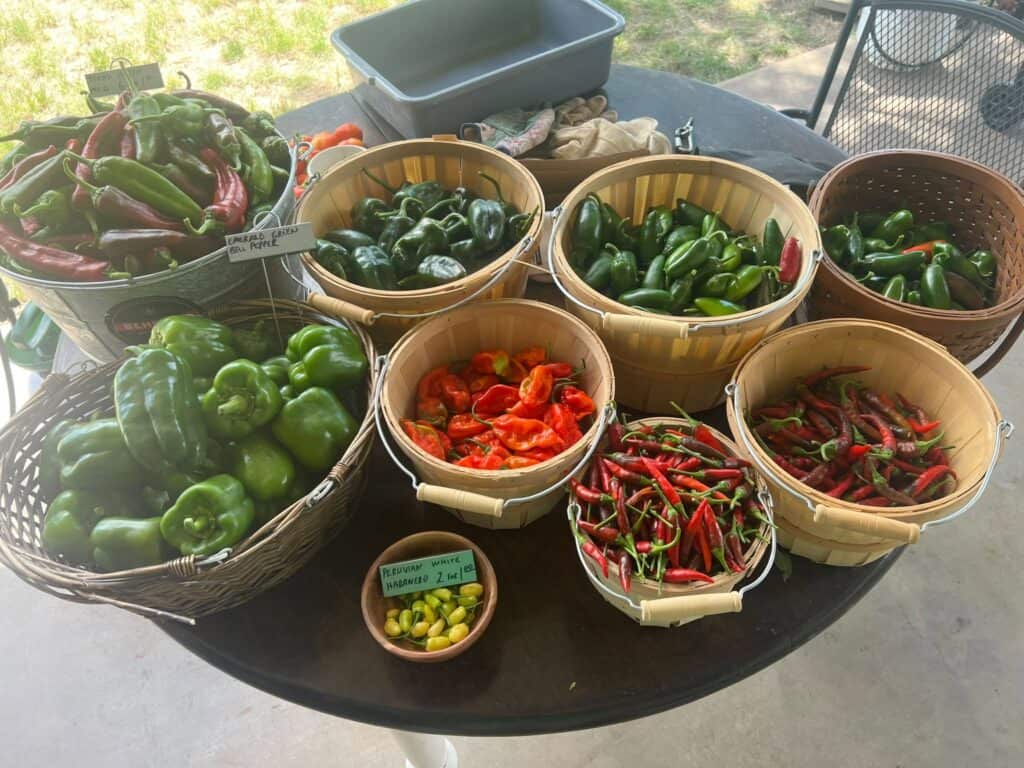
Later, those peppers end up in our hot sauce, pickled peppers, and other pepper products at the Buffalo Gap Farmers Market. As a result, one of the questions we hear most often is simple: how hot is it?
That’s where the Scoville scale comes in. In this guide, you’ll learn what the Scoville scale is, how labs measure pepper heat, where popular peppers land on the chart, and what a grower can do to make peppers hotter or milder.
How the Scoville Scale Works
The Scoville scale measures how hot a pepper is. Specifically, it rates heat in Scoville Heat Units (SHU). In other words, the higher the number, the hotter the pepper.
The scale gets its name from Wilbur Scoville, a pharmacist who created the test in 1912. His method was simple. First, he dissolved a dried pepper extract in alcohol. Then he diluted it with sugar water until a panel of tasters could no longer feel any heat. Finally, the number of dilutions became the pepper’s rating. For example, a bell pepper needs no dilution at all, so it rates 0 SHU. On the other hand, a jalapeño needs thousands.
How Pepper Heat Is Measured Today
Taste panels were a good start. However, everyone’s taste buds are different. So today, labs use a machine test called high-performance liquid chromatography (HPLC). It measures exactly how much capsaicin a pepper contains, and then labs convert the result into Scoville Heat Units.
Capsaicin is the natural compound that makes peppers hot. At full strength, pure capsaicin tops the scale at 16 million SHU.
That’s why you’ll usually see a range for each pepper instead of one number. For instance, two jalapeños from the same plant can taste quite different. Also, as you’ll see below, the way a grower raises a pepper makes a big difference.
Scoville Scale Chart: Peppers from Mildest to Hottest
Below, you’ll see where some of the most popular peppers land, from sweet bell peppers to the world’s hottest.
| Pepper | Scoville Heat Units (SHU) | Heat level |
|---|---|---|
| Bell pepper | 0 | Sweet |
| Banana pepper | 0 to 500 | Mild |
| Shishito | 50 to 200 | Mild |
| Pepperoncini | 100 to 500 | Mild |
| Anaheim | 500 to 2,500 | Mild |
| Poblano (dried: ancho) | 1,000 to 2,000 | Mild |
| Jalapeño | 2,500 to 8,000 | Medium |
| Fresno | 2,500 to 10,000 | Medium |
| Serrano | 10,000 to 23,000 | Medium |
| Cayenne | 30,000 to 50,000 | Hot |
| Tabasco pepper | 30,000 to 50,000 | Hot |
| Thai chili | 50,000 to 100,000 | Hot |
| Habanero | 100,000 to 350,000 | Extra hot |
| Scotch bonnet | 100,000 to 350,000 | Extra hot |
| Ghost pepper (bhut jolokia) | 855,000 to 1,041,000 | Superhot |
| Trinidad Moruga Scorpion | 1,200,000 to 2,000,000 | Superhot |
| Carolina Reaper | 1,400,000 to 2,200,000 | Superhot |
| Pepper X | about 2,693,000 | Superhot (current world record) |
| Pure capsaicin | 16,000,000 | Top of the scale |
Heat levels at a glance
- Mild: 0 to 2,500 SHU
- Medium: 2,500 to 30,000 SHU
- Hot: 30,000 to 100,000 SHU
- Extra hot: 100,000 to 350,000 SHU
- Superhot: 1,000,000 SHU and up
What Is the Hottest Pepper in the World?
Right now, the hottest pepper in the world is Pepper X. In October 2023, Guinness World Records named it the record holder, at an average of 2,693,000 SHU. As a result, it took the title from the Carolina Reaper, which held the record for about 10 years. Interestingly, Ed Currie of South Carolina bred both peppers.
To put that in perspective, Pepper X is roughly 300 to 1,000 times hotter than a jalapeño.
A Grower’s View: What Makes a Pepper Hotter?
The Scoville chart gives you a range. However, where a pepper lands in that range depends a lot on how it grows. After many seasons of growing peppers from seed, here’s what we’ve learned.
- Variety matters most. First and foremost, a pepper’s genetics set its heat range. No amount of care will turn a bell pepper into a habanero. That’s why we choose our seed carefully.
- Heat and sunshine add fire. For example, peppers that grow through a hot, sunny West Texas summer tend to be hotter than the same variety in a cooler place.
- A little stress turns up the heat. Plants that get slightly less water make more capsaicin. Too little water hurts the plant, though, so it’s a balance.
- Ripeness counts. In general, many peppers get hotter, sweeter, and more flavorful as they turn from green to their fully ripe color.
- Healthy soil grows flavorful peppers. We grow with 100% organic practices and focus on rich soil instead of synthetic fertilizers. After all, too much nitrogen gives you big, leafy plants and fewer peppers.
Want to start with healthy soil? Learn what a soil test tells you, and why we add mycorrhizae to our soil for stronger roots.
Where Is the Heat in a Pepper?
Most people think the seeds are the hottest part. Actually, most of the capsaicin sits in the white ribs inside the pepper, called the placenta. The seeds only taste hot because they touch it. So, to tame a pepper’s heat, scrape out the ribs along with the seeds.
A Tip for Seed Savers
Peppers can cross-pollinate when different varieties grow close together. This year’s peppers won’t change. However, seeds you save from them may grow into surprise peppers next year. So if you save seed, keep varieties apart or cover a few blossoms to keep them pure.
The 21 Peppers We Grew This Year
Every pepper in our garden starts as a seed we plant in late winter. Because we grow them using 100% organic practices, with no synthetic sprays or fertilizers, we know each pepper’s story from seed to bottle.
Want to grow some of your own? Start with our growing guides for pepperoncini peppers and Holy Mole peppers.
Here are the varieties we grew this season, grouped from mildest to hottest.
Sweet and Mild Peppers
These peppers bring plenty of flavor with little or no heat.
| Pepper | Scoville Heat Units (SHU) | Flavor |
|---|---|---|
| Emerald Giant | 0 | Crisp, classic green bell pepper |
| Red Marconi | 0 | Long Italian sweet pepper, great for frying and roasting |
| Mild jalapeño | under 2,500 | All the jalapeño flavor with very little heat |
| Poblano | 1,000 to 2,000 | Earthy; perfect for roasting and stuffing |
| Ancho | 1,000 to 2,000 | Grown for drying; rich and raisin-like once dried |
| Mild Hatch | 1,000 to 2,500 | Roasty, earthy New Mexico green chile flavor |
Medium and Hot Peppers
Next, the heat starts to build. Most of these work well in salsa, pickles, and everyday cooking.
| Pepper | Scoville Heat Units (SHU) | Flavor |
|---|---|---|
| Medium Hatch | 2,500 to 5,000 | The same great Hatch flavor with more kick |
| Cowhorn | 2,500 to 5,000 | Long and curved; great for pickling |
| Hot jalapeño | 2,500 to 8,000 | Bright and grassy, the classic |
| Hot Hatch | 5,000 to 10,000 | Hatch flavor with real heat |
| Serrano | 10,000 to 23,000 | Crisp and bright, like a jalapeño with more bite |
| Chile de árbol | 15,000 to 30,000 | Nutty and smoky; dries beautifully |
| Long slim cayenne | 30,000 to 50,000 | Sharp, clean heat; great dried and ground |
| Chile pequin | 40,000 to 60,000 | Tiny wild pepper native to Texas and Mexico, with a quick, fiery bite |
Extra Hot and Superhot Peppers
Finally, the fire-breathers. Wear gloves when you handle these!
| Pepper | Scoville Heat Units (SHU) | Flavor |
|---|---|---|
| Red habanero | 100,000 to 350,000 | Fruity and floral |
| Orange habanero | 100,000 to 350,000 | The classic habanero: fruity, floral heat |
| Yellow habanero | 100,000 to 350,000 | Bright and fruity |
| Peruvian white habanero | 100,000 to 350,000 | Creamy-white color with a fruity flavor |
| Scotch bonnet | 100,000 to 350,000 | Sweet and fruity, a Caribbean favorite |
| Ghost pepper | 855,000 to 1,041,000 | Fruity at first, then a slow, building burn |
| Carolina Reaper | 1,400,000 to 2,200,000 | Sweet first bite, then intense heat |
Keep in mind that heat ranges are approximate. Every pepper varies with the weather and its growing conditions, and ours grew up in a West Texas summer!
(Margaret: consider adding a line here about your favorite pepper, and which ones go into your hot sauce.)
From Our Garden to Your Table
When you buy our hot sauce or pickled peppers, you’re tasting peppers we grew ourselves. While most vendors buy produce to make their products, we grow it, from seed.
Want to make your own? Our guide to how to pickle and can peppers works with any variety on this chart. Also, if you’re planning your own pepper patch, grab our free Annual Garden Planner to map out what to start and when.
Best of all, our pepper products will be back at the Buffalo Gap Farmers Market on opening day, Saturday, May 1, 2027.
Too Hot? How to Cool the Burn
Because capsaicin doesn’t mix with water, a glass of ice water just spreads the heat around. Instead, try one of these:
- Dairy: milk, yogurt or sour cream. That’s because a protein in dairy called casein helps wash capsaicin away.
- Starch: bread, rice or a tortilla helps soak it up.
- A little sweetness or acid: similarly, a bite of fruit or a squeeze of lime can take the edge off.
Handling hot peppers? Wear gloves when you cut anything hotter than a jalapeño, and don’t touch your eyes. Even after you wash with water, capsaicin oil stays on your skin. Instead, wash your hands with dish soap, which cuts the oil.
Scoville Scale FAQ
How hot is a jalapeño on the Scoville scale?
A jalapeño rates 2,500 to 8,000 SHU. That puts it in the medium range. In other words, it has noticeable heat, but nowhere near a habanero.
What does SHU stand for?
SHU stands for Scoville Heat Units, the unit used to measure a pepper’s heat.
Is a habanero hotter than a ghost pepper?
No. A habanero rates 100,000 to 350,000 SHU. In contrast, a ghost pepper can top 1,000,000 SHU, which makes it about three times hotter or more.
Does cooking make peppers less hot?
Cooking doesn’t destroy capsaicin. Instead, it spreads the heat through the whole dish. Also, roasting can bring out a pepper’s sweetness, so the heat feels milder.
Do pickled peppers lose their heat?
Pickled peppers usually taste a little milder, because some capsaicin moves into the brine and the vinegar balances the heat. Even so, they’re still plenty spicy.
Can you grow hot peppers from seed?
Yes, and in fact, it’s how we grow all of ours. First, start seeds indoors 8 to 10 weeks before your last frost. Since peppers sprout best in warm soil, a heat mat helps. Also, some hot varieties can take 2 to 3 weeks to come up, so be patient.
Once they sprout, these guides will help your seedlings thrive:
- How often to water seedlings
- How to prevent damping-off disease, which kills young seedlings
- How to wash seedlings to control pests organically
Sources (for your reference, not part of the post)
- Hottest chili pepper (Wikipedia): Pepper X record details
- The Scoville Scale (Chili Pepper Madness): the post you shared as a model

