How to Safely Waterbath Can Pears
Episode 3 of Store Bought is here, and this one comes straight from a fellow vendor’s table. We didn’t grow these pears — we bought them from another seller at the Buffalo Gap Farmers Market. This is exactly how to safely water-bath can pears without needing a garden of your own — a trip to the market works just as well.
A Short History of Pears
Pears are one of the oldest cultivated fruits in the world. Genomic research traces the earliest wild Pyrus lineage back 65 to 55 million years to the mountainous regions of southwestern China, and from there pears dispersed both east and west, eventually giving rise to two distinct lines: Asian pears and European pears. Cultivation itself goes back thousands of years on both sides of that split — Asian pears have been cultivated for roughly 3,300 years, while European pears have been grown for more than 3,000 years, with named cultivars already being recorded as early as 300 BCE.
Pears show up in some of the oldest literature we still read today. In the Odyssey, Homer called pears a “gift of the gods,” and Roman writers including Cato, Varro, and Pliny the Elder documented dozens of pear cultivars being grown across the Roman Empire. By the time pear trees crossed the Atlantic with early colonists, they were already the product of thousands of years of cultivation — this is not a fruit that owes anything to modern farming.
Why This One’s Different
Every episode of Store Bought starts with the same idea: buy what you need, whether that’s a farmers market, a grocery store, or a warehouse club, and turn it into something worth keeping on the shelf. Most of this series has focused on grocery store hauls, but this episode leans into the farmers market side of that premise directly — supporting another local grower, buying what’s in season, and putting it up the same way you would anything else.
A Note on Safety
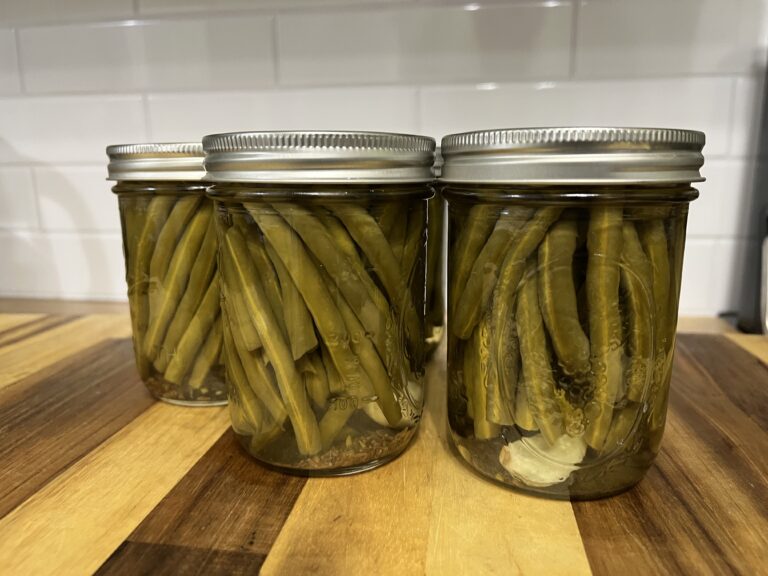
Unlike the dilly beans or pickled garlic, pears don’t need any added vinegar to be canned safely in a water bath. Pears are naturally acidic enough on their own, which means this is one of the more straightforward canning projects in the whole series. That said, we’re still following a tested recipe rather than guessing — in this case, one from the National Center for Home Food Preservation — because the exact hot-pack method and processing time are what actually make this safe, not just the fruit’s natural acidity alone.
How to Safely Waterbath Can Pears
Processing time: 20 minutes for pints (water bath), adjusted for altitude Headspace: ½ inch
For this batch, we’re canning pints and using plain water as the canning liquid instead of syrup. If you’ve read our piece on what “low sugar” actually means, this will look familiar — water is a fully safe, NCHFP-approved option right alongside sugar syrup, apple juice, or white grape juice. It just means the sugar content comes entirely from the pears themselves, nothing added.
Ingredients
- Fresh pears — Bartletts are the classic canning variety and hold their shape well, though most firm, ripe pears will work
- Plain water, for the canning liquid (or a light syrup, apple juice, or white grape juice, if you’d rather — all are safe NCHFP options)
- Bottled lemon juice, for keeping cut pears from browning while you work
Instructions
- Wash, peel, halve, and core the pears. Drop the prepared pieces into a bowl of water with a splash of lemon juice as you go, to prevent browning.
- Bring your canning liquid to a boil. Add the drained pears and boil for 5 minutes. Hot-packing this way gives noticeably better texture than packing the jars with raw fruit.
- Pack the hot pears into pint jars — halves work well packed cavity-side down — and cover with the hot canning liquid, leaving ½ inch of headspace.
- Remove air bubbles, wipe the rims clean, and apply the lids.
- Process in a water bath: 20 minutes for pints at 0–1,000 ft elevation. Add 5 minutes at 1,001–3,000 ft, or 10 minutes at 3,001–6,000 ft. (Canning quarts instead? NCHFP calls for 25 minutes at 0–1,000 ft.)
- Let jars cool undisturbed for 12–24 hours, then check the seals.
A Few Notes
- We’re using a water bath, not a pressure canner, on purpose. NCHFP specifically notes that the higher heat of pressure canning can cause pink discoloration in canned pears — boiling water canning is the better choice here, and it’s what the fruit’s natural acidity allows anyway.
- If you end up with Asian pears instead of a standard variety like Bartlett, NCHFP’s tested recipe for those specifically calls for adding 1 tablespoon of bottled lemon juice per pint jar directly into the jar before processing. Worth asking your vendor what variety you’re getting, since it changes this one detail.
- Choose pears that are ripe but still firm. Very soft, fully ripe pears tend to break down during processing rather than holding their shape.
More From Store Bought
This is Episode 3 — head over to the Store Bought hub page to catch up on Dilly Beans and Pickled Garlic if you missed them, and to see how to safely water-bath canned pears and every other episode as they go live.
If you’re local, come find us at the Buffalo Gap Farmers Market — and while you’re there, say hello to the vendor these pears came from too. Supporting each other is as much a part of this market as anything we can.
Sources & Further Reading
Diversification and independent domestication of Asian and European pears, Genome Biology — on the genomic history and domestication timeline of Pyrus species.
National Center for Home Food Preservation — “Pears, Halved.” The tested hot-pack method and canning liquid options this recipe is based on.
National Center for Home Food Preservation — “Pears, Asian.” Covers the additional lemon juice requirement specific to Asian pear varieties.
USA Pears — “History of Pears.” On pears’ long history of cultivation and their journey to North America.